Women have always led under pressure. We have guided families, movements, teams, organizations, and communities, often all at once. Yet for generations, the measure of women’s leadership success has focused more on endurance than on sustainability. How much can you carry? How long can you push? How well can you perform while quietly absorbing the cost?
During Women’s History Month, it’s important to acknowledge a truth that often goes unspoken: burnout is not a personal failure. It frequently stems from leadership models that were never fully designed with the realities or well-being of women in mind.
This is where the transition begins.
Transition occurs when women stop normalizing exhaustion and start questioning the systems, expectations, and narratives they’ve inherited. It is the recognition that working harder is no longer the answer, and that success defined by depletion is not true success at all. For many women leaders, this transition happens after years of high performance, loyalty, and overextension. The wake-up call is rarely subtle; it manifests in health challenges, emotional fatigue, disengagement, or the quiet realization that something meaningful has been lost along the way.
Transformation follows when women begin to redefine leadership from the inside out.
Transformation is not about opting out of leadership; it’s about reshaping it. Women are changing the landscape of leadership by prioritizing wellness as a strategic objective rather than an afterthought. They are asking better questions: What does sustainable leadership look like over a career, not just a quarter? How do clarity, boundaries, and self-awareness strengthen decision-making? What happens when leaders model well-being instead of martyrdom?
This shift is powerful because it reframes wellness as a leadership competency. Emotional intelligence, energy management, and self-regulation are not “soft skills”; they are essential capabilities in today’s complex, high-pressure workplaces. Women leaders are demonstrating that you can lead with strength and humanity, authority and care.
And then there is thriving.
Thriving leadership is not about performative balance or perfectly curated self-care. It is leadership that is rooted, intentional, and resilient. When women thrive, they lead with presence rather than pressure. They build cultures where people are seen, supported, and held accountable. They make decisions that consider both outcomes and impact. They recognize that sustainability is not a luxury; it is a responsibility.
Women redefining success are not lowering the bar; they are raising it.
Lanota is a dual master level clinician. She received a Master’s in Public Administration from the University of Maryland System in 2012. She received an M.Ed. in 2017, from Liberty University. Lanota is a licensed professional counselor who, for the last several years, has worked in the field, serving in several roles, from therapist to enrollment.
Lanota has spoken for the Fulton County School District, The Nurses Association of Georgia, The City of Atlanta, The Gathering Spot, and several nonprofits. Lanota also serves as Vice President of Guide My Heart, a non-profit organization here in Georgia, and on the board of Beautiful Butterflies Inc., based in Maryland.
Education
· Bachelor of Arts (Sociology), University of South Carolina
· Master of Public Administration, University of Baltimore
· Master of Education, Liberty University
Licensure, Certifications, and Professional Affiliations
Effective leadership under prolonged stress isn’t defined by perfection, bravado, or endless stamina. It’s defined by stewardship. It’s important to lead with clarity, consistency, and care when the pressure doesn’t let up, and the horizon feels uncertain. In seasons of sustained disruption, leadership stops being about charisma and starts being about capacity.
Strong leadership during stressful times is anchored in clarity of decision-making rather than in the volume of decisions. Prolonged stress can create a false sense of urgency, compelling leaders to act quickly and constantly. However, effective leaders take the time to slow down the right processes. They prioritize what truly matters, reduce cognitive overload for their teams, and make fewer but more impactful decisions that align with core values and long-term objectives. They communicate the rationale behind their decisions clearly, recognizing that clarity reduces anxiety and builds trust in unstable circumstances.
Another key characteristic of effective leaders is relational equity. Those who excel under sustained stress invest intentionally in their people, not just in performance metrics. They understand that burnout, disengagement, and moral injury accumulate gradually rather than appearing suddenly. Effective leaders check in with their teams without micromanaging, listen without defensiveness, and foster a culture of psychological safety in which concerns can be raised early rather than after damage has occurred. They recognize that relationships are not merely “soft skills,” but essential elements of risk management.
Equally important is adaptive resilience. This trait involves knowing when to recalibrate, delegate, or change course entirely; it is not about pushing through at all costs. Leaders facing prolonged stress must be willing to abandon outdated approaches and embrace real-time learning. They normalize recalibration, signaling to their teams that flexibility is a strength, not a failure. This mindset nurtures innovation, even in constrained environments.
Finally, effective leadership during extended stress is rooted in personal sustainability. Leaders who neglect their well-being ultimately compromise their effectiveness, regardless of their skills. Sustainable leaders establish boundaries, leverage support systems, and model healthy performance expectations. They understand that leadership is a long-term endeavor that requires intentional recovery, reflection, and alignment.
In essence, leadership under prolonged stress is less about heroic efforts and more about intentionality. It involves navigating complexity, maintaining humanity, and leading with purpose during challenging times. Organizations need leaders who may feel the strain but know how to guide their teams through it, positioning their people and their culture not just to survive but to transition, transform, and ultimately thrive.
If prolonged stress is impacting you and/or your areas of responsibility, I welcome the opportunity to strategize ways to change that narrative.
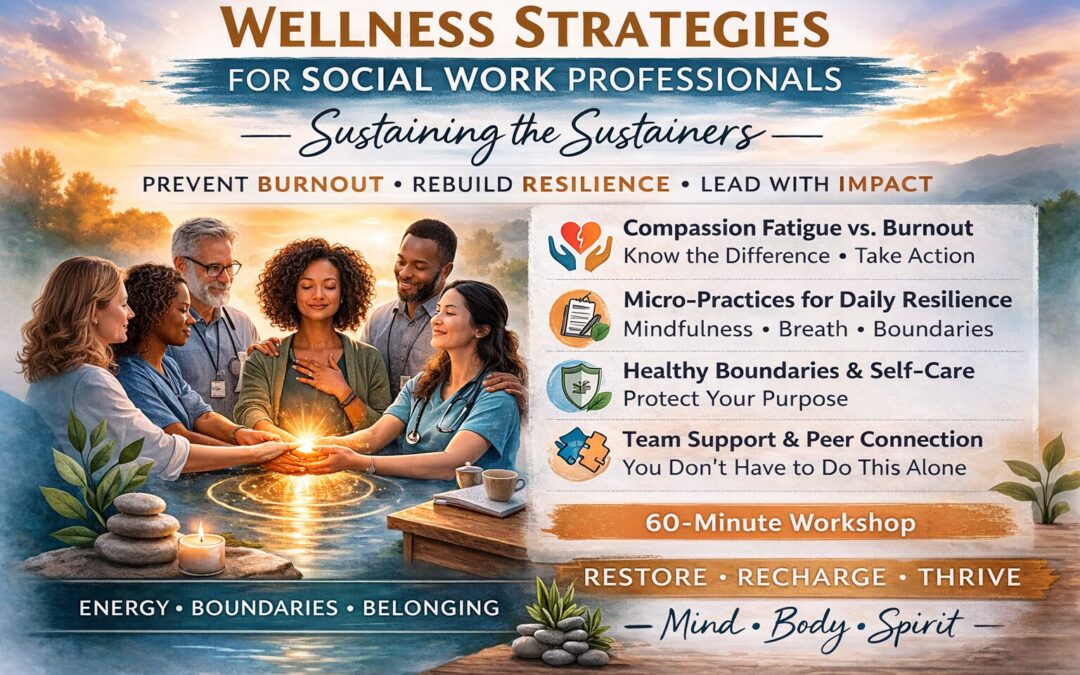
Social work calls for deep compassion, steady presence, and relentless care for others. This often comes at the expense of one’s own well-being. This 60-minute workshop creates space to name the difference between compassion fatigue and burnout, normalize the weight social workers carry, and offer practical ways to restore harmony without guilt. Participants will explore simple, realistic micro-practices that support resilience, strengthen healthy boundaries, and protect the purpose that drew them to this work in the first place. Because sustaining the mission starts with sustaining the people doing the work.
While this is definitely open to everyone (because wellness impacts us all), the emphasis will be on highlighting professionals in social work/social services to recognize March as Social Work Awareness Month.
Most organizations today can point to a wellness policy. Flexible work statements. Employee assistance programs. Mental health days. Well-being commitments proudly displayed on websites and in handbooks.
And yet, employees often tell a different story.
So what causes the gap between wellness policies and actual practice?
It’s rarely a lack of good intentions. More often, it’s a breakdown between what leaders say they value and how work is truly designed and rewarded.
Wellness Is Declared But Not Operationalized
One of the biggest causes of the gap is that wellness lives at the level of language, not systems. Policies exist, but they are not embedded into performance expectations, workflows, or leadership behaviors.
When productivity metrics reward overwork, speed, and constant availability, wellness policies become optional in practice—even if they’re mandatory on paper. Employees quickly learn what really matters by watching what gets praised, promoted, and protected.
Culture always outperforms policy.
Leadership Behavior Sends Mixed Signals
Another critical factor is leadership modeling. Leaders may support wellness conceptually, but their actions often communicate something else.
When leaders:
Regularly work late and expect rapid responses
Cancel time off or discourage disconnecting
Treat burnout as a personal weakness rather than a system issue
Employees receive a clear message that says wellness is encouraged, but only if it doesn’t interfere with output. This inconsistency erodes trust and widens the gap between stated values and lived experience.
Workload Design Undermines Well-Being
You cannot wellness-program your way out of an unsustainable workload.
Many organizations offer wellness benefits while simultaneously operating with understaffed teams, unclear priorities, and constant urgency. In these environments, employees don’t lack wellness resources—they lack capacity.
When work is designed without margin, wellness becomes another task to manage rather than a condition that supports performance.
Accountability Stops Short
Wellness often lives in HR or internal communications, but accountability rarely reaches senior leadership or people managers. When leaders are not evaluated on how they support sustainable performance, wellness remains peripheral.
Bridging the gap requires asking harder questions:
Are leaders trained to lead people, not just results?
Are managers supported in setting boundaries and prioritizing well-being?
Are there consequences for behaviors that consistently undermine wellness?
Without accountability, policies become promises without power.
Closing the Gap Requires Alignment
The gap between wellness policy and practice closes when organizations align values, behaviors, and systems. That means designing work that allows people to recover, training leaders to lead with clarity and care, and measuring success beyond short-term output.
Wellness is not a perk. It’s a performance strategy.
Organizations that understand this don’t just retain talent—they build resilient, engaged, and high-performing teams.
This is the work of leadership in transition.
If this sounds like a topic occurring within your business or organization, I welcome the opportunity to explore ways we can work together.